

What is Document Management for Major Projects?
Document management refers to the practice of storing, organising, accessing, and maintaining business and project documents in a central, structured system. For project-driven industries, document management forms the foundation for effective collaboration and information governance.
“Document management is the foundation for storing, organising, and accessing project files. It ensures teams have a central repository where documents are easy to find and kept up to date.”
-Joel Gray, 'Document Control and Document Management: What's the Difference'
On major capital projects, document management rarely stays simple. These environments generate huge volumes of documentation: engineering deliverables, vendor packages, contracts, procedures, inspection records, correspondence, and the list goes on. At this scale, even basic tasks like locating the latest approved document or understanding what changed between revisions can become a daily friction point.
 Revision control is another core part of document management in capital projects. Drawings, specs, and supporting files change frequently as design develops and issues are resolved. Strong revision tracking helps teams maintain a clear history of what has been updated, while making it obvious which file is current and approved for use. When this is handled well, teams spend less time double-checking their work and more time moving work forward with confidence.
Traceability is where document management starts to support governance and compliance. A capable document management system records key actions such as uploads, downloads, status updates, and workflow assignments, creating an audit trail that supports accountability. For regulated or safety-critical environments, that record can be just as important as the document itself.
Related Content
Why Document Management? (Hint: Single Source of Truth)
Document management gives project teams a reliable way to store and share documents so everyone can work from the same set of files. It supports day-to-day internal collaboration by keeping information organised, searchable, and available to the people who need it.
Document management helps project teams:
- Reduce time lost searching across drives, inboxes, and personal folders,
- Manage revisions so they can find the latest approved version,
- Maintain control and accountability with permissions and audit history, and
- Comply with industry information management standards (e.g. ISO 19650, ISO 9001 (Quality Management), ISO 15489 (Records Management), ISO 21500 / Project Management Standards, CFIHOS (Capital Facilities Information Handover Specification), NORSOK, etc.
Document management does this by supporting the core actions teams perform every day: uploading, editing, sharing, and quickly finding documents using search and metadata. With access control, revision control, and audit logging built in, it reduces common project risks like rework from incorrect revisions, delays caused by missing files, and traceability gaps that can contribute to claims or regulatory issues.
Common Challenges for Document Controllers
Document controllers are responsible for keeping project information organised, accessible, usable, accurate, and updated for the people who need it, when they need it. On major capital projects, that job gets harder as documentation grows, requirements tighten, and more partners contribute content across the supply chain. The most common challenges include:
Stricter Information Quality Requirements
Owners and clients are raising the bar on how documents are structured, named, tagged, and delivered. When quality rules are unclear, inconsistently applied, or enforced late, document controllers can end up spending a considerable amount of time fixing issues after upload and chasing teams for rework. That can slow down day-to-day collaboration and make it harder to maintain a reliable repository.
Rapid Growth in Volume and Variety of Documents
Engineering and project teams are dealing with more information than ever with thousands of documents and drawings to manage, and they all need to be stored in a way that supports fast retrieval. Without strong search, metadata, and consistent organisation, your team just wastes time hunting for files and may unknowingly use the wrong version.
Fluid, Globally Distributed Supply Chain Collaboration
Capital projects rely on contributors spread across companies, time zones, and systems. As partners join, change, and hand work off, the flow of documents becomes harder to manage. Document controllers often have to bridge gaps between different ways of working while keeping access controlled and ensuring the right people can find and share the right information without creating duplicates.
High User Expectations vs. Real-World Security and Adoption Constraints
Many users expect document tools to feel as simple as consumer apps, but project documentation comes with complex and strict security requirements. Permissions, audit needs, revision tracking, and the technical nature of engineering content can create friction if the system is not intuitive. When adoption suffers, teams revert to email or local storage, which undermines the central repository and weakens traceability.
Document Control and Document Management: What's the Difference?
Document control and document management are often treated as interchangeable, but they solve different problems on capital projects. Document management focuses on the basics teams rely on every day: storing files in a central place, keeping them organised, and making them easy to find and share. Document control sits on top of that foundation by adding governance, defined steps/automated workflows, and accountability so documents move through the right process and reach the right people in the right state.
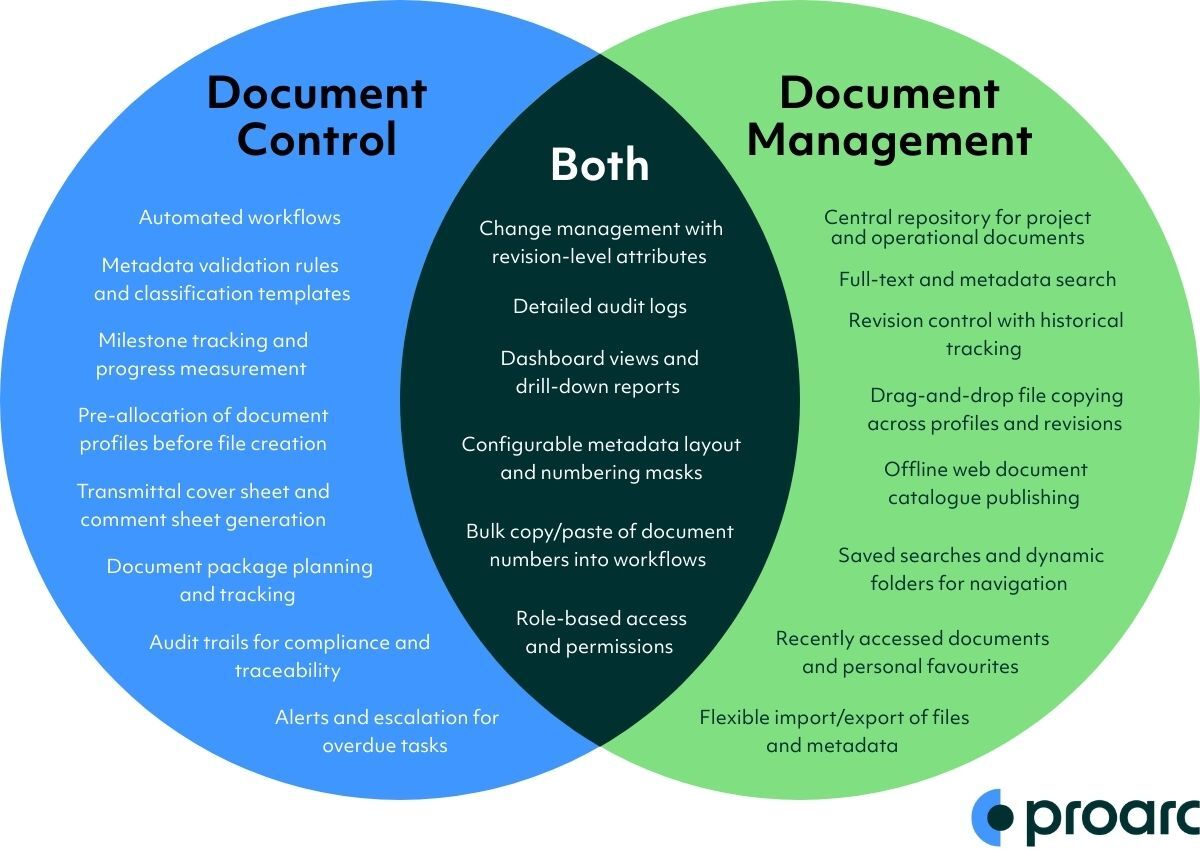
The confusion is understandable. Both practices deal with the same project information, and many platforms include overlapping features such as version history and permissions. That overlap can blur the line between “we have a place to store documents” and “we have a controlled process that enforces standards, approvals, and distribution.” The difference matters because capital projects depend on timing, accuracy, and traceability. When teams assume one discipline covers the other, gaps show up fast.
At a practical level, mixing the two up can introduce real project risk. Without the right balance, teams can run into issues such as non-compliance with client standards, rework caused by incorrect revisions, delays from stalled workflows, loss of traceability that can lead to claims or disputes, and late engineering deliverables.
Proarc Engineering Document Management software supports both document control and document management, as well as their shared processes.
Related Content
Document Management Benefits
Document Management Benefits by Project Phase
When teams on major projects run document management and document control together, they get a stronger foundation for day-to-day collaboration and a more consistent way to maintain information quality, accuracy, and traceability. This results in fewer delays caused by missing or outdated files, smoother coordination across disciplines, and clearer accountability for who did what and when.
Engineering: Managing Complex Technical Deliverables
Engineering projects generate complex, interrelated technical information that goes well beyond basic file storage. A document management system purpose-built for industry helps teams handle specialized document types, maintain structured revision history, and keep review cycles moving without losing control of accuracy or compliance.
The benefits of document management for complex engineering projects include:
- Handles complex engineering document types, including multi-file packages and referenced content
- Maintains registered revision history so teams can track official changes clearly
- Links documents to technical context such as equipment tags, systems, work packages, and project phases
- Improves search and retrieval with metadata-driven navigation and advanced, reusable queries
- Supports standards compliance through configurable numbering, classification, and access controls
- Reduces delays with workflow automation for reviews, approvals, and discipline-specific checks
- Enables controlled collaboration with external parties without relying on email file copies
- Integrates with Microsoft 365 tools so teams can work in familiar applications while staying in control
Construction: Reducing Risk and Supporting Claims
On industrial construction projects, document management has a direct impact on risk, schedule confidence, and dispute readiness. When teams can validate incoming information, track document status, and control how revisions are shared, fewer issues slip into the field and fewer delivery problems turn into claims.
The benefits of document management for major construction projects include:
- Offers access to documents from mobile devices, including low-bandwidth or offline situations
- Maintains updated revisions with traceability to approved changes by authorised stakeholders
- Keeps drawings, specifications, vendor data, and correspondence organised in a structured repository
- Enforces required metadata and consistent naming so documents are easier to verify and retrieve
- Improves revision control so field teams work from the latest approved information
- Provides clearer visibility into document status, approvals, and upcoming deliverables
- Creates audit-ready traceability of who issued what, when it was issued, and what changed
- Supports more reliable handovers through controlled transmittals and packaged delivery
- Reduces rework and cost overruns caused by outdated or incomplete information
- Strengthens claims support by making evidence easier to find and harder to dispute
Document Management Benefits by Stakeholder
Those are the benefits to the overall project, but what are some of the ongoing benefits for individual stakeholders? Understanding and communicating the value to each stakeholder is critical to achieving buy-in, adoption, and ensuring that project teams realize the full value of their document management and document control processes.
Project Planners
Project planners are expected to have a holistic understanding of each project and have everyone’s role in mind. The best planners use a document management system that allows them to assign deadlines to work objectives and can present them daily with visual data to ensure all work is proceeding according to schedule.
As a planner, you’ll see the following benefits from document management (supported by an engineering document management system):
- Organise and track document status so materials and deliverables align with the latest revision levels
- Assign deadlines to document-related work objectives to better support schedule-driven planning
- Use visual progress data to monitor work against timelines and bring clearer updates into internal meetings
- Review documentation in a way that fits existing workflows, reducing friction during execution
- Export and integrate documentation data with third-party planning tools such as Microsoft Project and Primavera P6
Engineering Discipline Leads
Project discipline leads are responsible for a plethora of content at multiple stages of project development. Document management (supported by the right solution) allows discipline leads to remain informed and give critical feedback that demonstrates their competency to their peers and superiors.
As a discipline lead, you’ll see the following benefits from document management (supported by an engineering document management system):
- Enforce project coding and numbering standards to help protect technical quality from the start
- Set the right permissions and access so teams can work efficiently without losing control of key documents
- Review documents and share feedback more easily, supporting stronger quality and collaboration with other disciplines
- Use configurable workflows that align with client standards and internal best practices
- Access visual reporting, such as timelines, status lists, and task views, to stay connected to progress across the discipline
Document Management Software
 If you’re ready to make project and operational information easier to find, safer to share, and simpler to keep up to date, then it’s time to implement a purpose-built document management solution like Proarc Engineering Document Management Software (EDMS). A strong EDMS gives teams a central source of truth for documents and related data, so people spend less time chasing files and more time delivering quality work on schedule.
Proarc is built for documents, process, and progress, giving major projects teams a reliable repository for day-to-day document management, with built-in support for document control processes such as validating, reviewing, approving, tracking, and distributing documents as documentation moves from early requirements through handover and into operations.
Proarc equips you with:
- A central repository for project and operational documents
- Full-text search powered by Azure AI Search, with ranked results across supported file formats, plus metadata search to narrow results quickly
- Revision control with historical tracking
- Drag-and-drop file copying across profiles and revisions
- Offline web catalogue publishing
- Saved searches and dynamic folders for navigation
- Recently accessed documents and personal favourites
- Flexible import/export of files and metadata
- Document control functionalilty including publish files activity for external integration
- Collaboration tools
Core Components of Document Management Software
Document management software provides the foundation teams need to store, organise, and retrieve engineering and project documentation at scale. Proarc includes the core components of effective document management for major projects, and has been designed to keep documents easy to find, up to date, and traceable across projects and operations.
Here are the essential components you should expect from a modern document management system like Proarc:
Central Repository and Structured Access
A strong document management system gives teams a single repository for project and operational documents and related data. This central access reduces time lost searching across shared drives, inboxes, and duplicated file stores. It also helps teams stay aligned by ensuring everyone is working from the same set of managed documents, with consistent organisation across repositories.
Revision Control and Change Management
Revision control is critical on capital projects where documents change frequently as design evolves and deliverables move toward completion. Proarc supports change management with advanced revision control and access to historical revisions, so teams can understand what changed over time and confidently locate the current, trusted version. This helps reduce rework caused by using outdated information and supports more consistent project execution.
Search and Retrieval Built for Engineering Information
Search needs to work the way engineering and project teams work. Proarc supports both full-text search using Azure AI Search and metadata searches, so users can quickly locate the right documents using the terms, tags, and project codes that matter to them. Strong search reduces reliance on manual browsing and helps teams move faster when they need answers quickly.
Metadata Rules for Numbering, Classification, and Validation
Document management breaks down fast when metadata is inconsistent. Proarc includes flexible configuration to define metadata rules for numbering, classification, and validation, helping teams apply project standards and reduce duplication and confusion. Multiple metadata layouts can be configured for each repository, giving different teams tailored views that make it easier to find, manage, and maintain document quality across large volumes of information.
Audit Trails and Traceability for Everyday Accountability
A dependable document management system should make it easy to answer basic questions such as who changed a document, what status it was in, and when it was accessed. Proarc maintains detailed audit records for actions and events in the system, including document status changes, workflow assignments, electronic signatures, and file downloads. This supports traceability for internal governance, audits, and day-to-day accountability without forcing teams to build manual tracking spreadsheets.
File Authoring and Microsoft 365 Integration
Document management should fit naturally into how teams create and edit documents. Proarc supports consistent document creation using predefined templates with data merge and automatic updates, and it integrates with Microsoft Office 365 for authoring and editing. This helps standardise outputs, reduce formatting errors, and keep documents current while allowing teams to work in familiar tools. Proarc EDMS has support for other engineering file formats and conversion to PDF with embedded PDF viewing, and engineering markup tools.
Document Management for Major Projects Case Studies
A critical consideration before selecting document management software is understanding whether it can deliver real outcomes for projects and operations.
For an example of how Proarc Engineering Document Management Software has been used to strengthen document management practices at scale and support consistent information handling across complex capital projects, see the following case study:

|
Global Offshore EPC Migrates to Enterprise Engineering Document Management SaaSA major offshore and subsea EPC operating in regulated environments moved away from fragmented, manual approaches to document handling and implemented a governed, cloud-based backbone using Proarc EDMS. The initiative supported an enterprise-scale user base of 5,000+ users |
Document Management for Major Projects FAQs
1. What is document management for major projects?
Document management for major projects is the practice of storing, organising, and maintaining documents so teams can reliably find the right file, keep it up to date, and share it with the right people. In engineering and capital projects, it supports controlled access, revision history, search, and traceability so project information stays usable across the full lifecycle, from early design through handover and into operations.
2. Is SharePoint good for document management on major projects?
SharePoint can work for basic file storage and internal collaboration, but it often struggles as the primary system for major projects with heavy engineering documentation. Teams typically need structured metadata and numbering, controlled external collaboration, workflow-driven reviews, progress tracking tied to milestones, and audit-ready history. When those needs grow, SharePoint usually requires significant configuration and strict governance, and many teams still end up relying on email attachments and spreadsheets to fill gaps. SharePoint also encourages distributed file storage and proliferation of uncontrolled file copies, which introduces risk of incorrect information.
3. Document management vs document control: what’s the difference?
Document management focuses on keeping documents easy to store, find, and share with revision history and access control. Document control adds the formal rules and process steps around reviews, approvals, issuance, and compliance, including clear ownership and traceability throughout the lifecycle. On capital projects, they work best together: document management provides the reliable foundation, and document control ensures the right documents move through the right steps at the right time.
4. What is document management software?
Document management software is the system teams use to store and manage project and operational documents in a central repository. It typically includes revision control, role-based access, audit logs, and strong search so users can quickly retrieve the right information. In cloud deployments, it also supports secure access from anywhere and helps keep collaboration governed through workflows and tracked activity, instead of scattered attachments and manual follow-ups.
5. Why is document management important?
Document management matters because small information mistakes create big downstream cost. When teams cannot trust document status, revision history, or access controls, the risk climbs quickly: rework from outdated drawings, compliance failures, safety exposure, uncontrolled collaboration through email copies, and weaker traceability when claims or disputes arise. A well-structured system reduces these issues by keeping documents current, searchable, controlled, and auditable across internal teams and external partners.
Latest insights