
A global offshore engineering, procurement, and construction company (EPC) operating in regulated environments replaced fragmented, manual document control with a governed, cloud-based engineering document control backbone using Proarc Engineering Document Management Software (EDMS) in order to improve document quality, standardize workflows across regions, and create more consistent information handling on complex capital projects.
This case study shows how the team planned and executed an enterprise migration (supporting 5,000+ users) and connected Proarc with core Product Lifecycle Management (PLM) and scheduling systems to keep document status, milestones, and progress aligned across engineering, planning, and document control.
Key takeaways
-
A global offshore EPC replaced fragmented, manual document control with Proarc EDMS to establish a governed, cloud-based backbone for engineering information
-
The migration helped standardize workflows across regions, improve document quality, and reduce the risks associated with inconsistent local practices
-
Integrations with PLM and scheduling systems aligned document status, milestones, and progress across engineering, planning, and document control
-
The enterprise rollout supported more than 5,000 users and gave document controllers, planners, and engineers more reliable access to controlled information
-
By moving to an enterprise EDMS, the organization created a more scalable foundation for governance, project visibility, and future growth
Jump to
- What is the company and project background?
- What document control challenges were they facing?
- Why did they select Proarc EDMS?
- What was the EDMS migration process like?
- What EDMS integration support did they need?
- What were the results and what was the operational impact?
- Summary: How did unified project information help this global EPC?
- FAQs
What is the company and project background?
The subject of this case study is a major offshore EPC that operates across global centres of engineering, manufacturing and project execution. The company delivers major offshore projects that require close coordination between engineering teams, document controllers, suppliers, planners and clients.
The company executes projects in highly regulated environments where the accuracy, accessibility and consistency of engineering information are essential for safe and timely project completion. Changes at the company over several years resulted in a myriad of different systems and approaches to document management and document control. This created inefficiencies and made it difficult to scale consistent practices across project teams.
The company recognized the need for a modern, cloud-based engineering document management solution that could standardize document control processes, streamline collaboration, integrate with core engineering systems and support global operations at an enterprise level.
Primary users included document controllers, planners and engineers, with a system footprint sized for a global user base of more than 5,000 users.
What document control challenges were they facing?
The company faced many challenges related to their document control processes and systems that resulted in the decision to migrate to a new solution and reset some of their practices.
Major challenges that led to this included:
-
Fragmented and inconsistent document practices
This global project-driven organization relied on multiple local systems and outdated tools. This created variation in document naming, approval workflows, supplier interactions and transmittal processes. As a result, there was a higher risk of rework, delays and miscommunication across disciplines.
-
High levels of manual work across the document lifecycle
Without a purpose-built engineering document management solution, their teams were often depending on spreadsheets, email or manual uploads to track revisions, approvals and milestone status. These manual steps increased administrative effort and introduced risk-laden errors.
-
Limited visibility across engineering and planning systems
Engineering teams, planners, and document controllers often worked in separate systems that did not communicate with one another. This led to misaligned statuses, duplicated data entry and poor insight into how document progress affects schedule forecasts.
-
Difficulty scaling on-premise or heavily customized systems
The organization relied on legacy and highly customized tools that struggled with slow upgrades, inconsistent performance and costly maintenance. These constraints made it difficult to introduce global standards and support rapid digital transformation.
Why did they select Proarc EDMS?
The team evaluated vendors and chose Proarc based on fit and execution approach:
-
Fit for Engineering Document Control
Proarc provides structured workflows for the full engineering document lifecycle. This includes document registration, metadata control, revision management, approvals, transmittals, and handover. These capabilities align with how engineering, procurement and construction organizations manage documentation in regulated projects.
-
Standardization at Enterprise Scale
The configuration model supports consistent governance across business lines and regions without relying on bespoke customization. This allows teams to work with predictable behaviour and reduces variation in local practices.
-
Integrations that Connect Core Systems
Proarc integrates with Product Lifecycle Management (PLM) and scheduling systems so that teams can work in their preferred tools while sharing current information. In this deployment, integrations were defined for the company's PLM system and master scheduling system. This keeps document status, selected files, milestones and progress aligned across systems and project teams.
-
Delivery Approach Aligned to Company Expectations
The delivery approach addressed the company's requirements by providing:
- A documented compliance posture and controls.
- Delivery coverage that supports a distributed user base.
- A clear project management framework for planning, execution and stakeholder engagement.
- Defined methods for planning, implementation and testing to manage risk during rollout.
- References relevant to large, project‑driven engineering environments.
Additional assessment criteria
Additional assessment criteria included:
- Supplier compliance programs and supporting evidence.
- Supplier presence at global, national, regional and local levels.
- Supplier project management approach for complex, multi‑site deployments.
- Supplier methodologies for planning, implementation and testing.
- Quality and relevance of customer references.
What was the EDMS migration process like?
The recommended plan balanced continuity for live projects with the goal of establishing a standard, cloud-based platform connected to core enterprise systems. Since the organization had existing systems, they needed a reliable migration strategy that would ensure all information was moved and accurately accounted for, as well as ensuring all team members were trained and adopted the new system and structure.
Key elements that helped the migration plan succeed included:
-
- Targeting architecture and early integration planning
- Dual-track environment setup to protect project continuity
- Configuration strategy that focused on long-term simplicity
- Extended align and design phase to strengthen fit and adoption
- Ability to refine repository scope as needs became clearer
- Enterprise-scale deployment
What EDMS integration support did they need?
The organization needed its core systems to work together so that engineering, planning and document control could operate from the same real-time data. Teams were entering the same information in multiple places, and status updates were not always consistent across tools.
Since Proarc EDMS serves as the central system for controlled engineering documents, connecting it to the PLM and scheduling software was necessary to keep information current and reliable across disciplines.
|
Integration |
Goals |
What Flows Between Systems |
Why It Works |
|
PLM |
Keep engineering design data in PLM system aligned with controlled documents and workflows in Proarc. Reduce duplicate entry and improve confidence in status information across both systems. |
Document data and metadata. Status updates and selected files. Information moves in both directions when needed. |
Document controllers choose which documents and which versions are synchronized. Full audit trails and retry options are available for transparency and correction. |
|
Achieved Outcomes |
|||
|
|||
|
Integration |
Goals |
What Flows Between Systems |
Why It Works |
|
Scheduling Software |
Link document-related work in Proarc with the master project schedule in scheduling system. Give planners and document controllers a shared and current view of progress without changing the tools they prefer to use. |
Planned activities and key schedule fields move from scheduling system into Proarc. Proarc calculates progress, forecast dates and actual dates, including percentages where applicable. These calculated values are written back to scheduling system so that both systems show the same progress. |
Data exchange uses APIs and a user-controlled integration application. The flow is deliberate and auditable to support predictable updates. |
|
Achieved Outcomes |
|||
|
|||
What were the results and what was the operational impact?
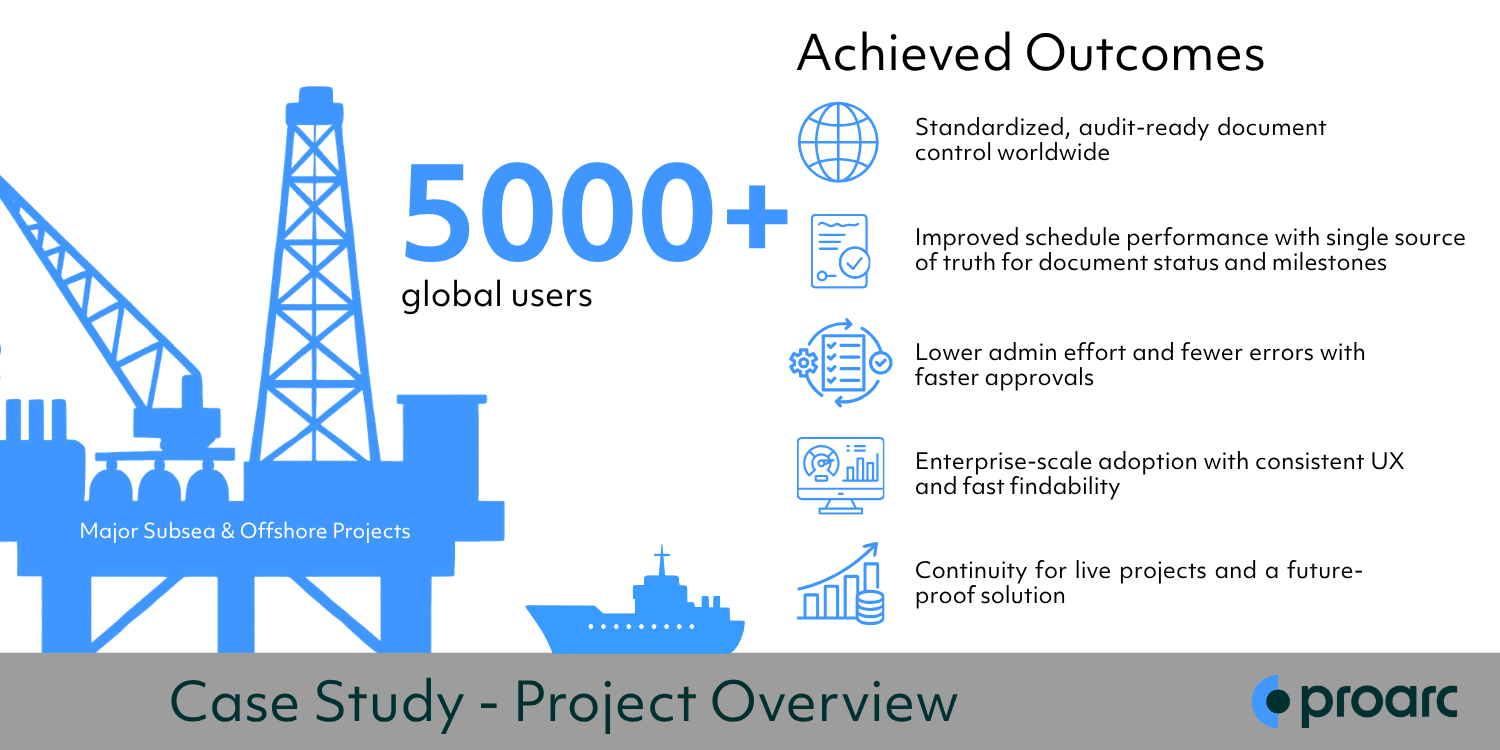
Above: Case Study Project Overview
Standardizing on Proarc Engineering Document Management Software helped the organization move from fragmented practices to a consistent, connected approach to engineering information. The outcomes reflect both the scale of the rollout and the decision to integrate Proarc with core enterprise systems used for product lifecycle management and project scheduling.
1. Improved quality of engineering documents
Standard workflows for registration, metadata, revision and approval helped reduce manual steps and errors, which supports higher productivity and quality in released deliverables.
2. More consistent customer service across global business units
A common configuration and predictable behaviour across regions made document handling and transmittals more consistent for clients and suppliers.
3. Better schedule performance
Integrations with PLM and scheduling systems aligned document status and milestones with the master schedule, which supports clearer forecasts and fewer mismatches.
4. Enterprise scale and adoption
The global rollout included more than 5,000 users across regions, including document controllers, planners and engineers who now have reliable access to governed engineering documents and workflows.
5. Connected engineering and planning
Through integrations with PLM and scheduling platforms, Proarc enabled automated, system-to-system document flow. The result is more consistent document status information across systems and fewer points where manual updates are required.
Document controllers can keep Proarc as the point of control for governed documents while still aligning status, selected files and milestone dates with PLM and scheduling systems. This supports clearer planning and forecasting in the master schedule without forcing users to change their primary tools, leading to better decision-making.
6. Standardized governance with a cloud-based approach
A standard enterprise Software as a Service configuration reduced the long-term risks associated with bespoke customization. This made rollout and governance simpler and helped establish consistent behaviour across regions.
7. Improved structure and findability
Repositories were structured by business line and by project, and each repository used the appropriate templates, metadata and workflow steps for that area’s deliverables. This structure makes information easier to find and keeps document handling consistent across teams.
8. Strong user confidence and engagement
Stakeholders provided consistently positive feedback and maintained close engagement with consultants, which signalled growing trust in the platform and in the supporting delivery team.
9. Unified control across regions
The organization achieved more unified document control and more streamlined cross-regional workflows. This contributed to smoother project execution and more consistent information management practices.
10. Foundation for future growth
By adopting Proarc as an enterprise SaaS EDMS and integrating it with the wider application landscape, the organization created a scalable, future-ready foundation that supports both new and legacy project environments.
Summary: How did unified project information help this global EPC?
This global EPC organization selected Proarc EDMS to replace inconsistent document practices with a modern, cloud-based solution capable of supporting large-scale engineering projects. Through integrated workflows, improved governance and strong connections to core enterprise systems, the company achieved more streamlined processes, more accurate project visibility and a scalable foundation for future growth.
To explore how Proarc EDMS can standardize governance and manage document control across the global scale of your business, download the Proarc EDMS brochure today.
Last updated: Sept 2026