

This interface management case study highlights how a $13B oil and gas megaproject in northern Canada not only maintained its schedule but also effectively mitigated interface-related risks by leveraging Coreworx Interface Management software as its digital foundation. Together, these approaches aligned multiple contractors, supported safe tie-ins and handovers, and enabled rapid recovery from contractor turnover and environmental evacuations.
This case study is for project owners, EPC and delivery teams, interface managers, and project controls leaders working on complex oil and gas or other capital projects. You can use this case study when evaluating whether a project needs a formal interface management program, how to structure the people, process, and tools involved, and how a purpose-built interface management system can support delivery from engineering through construction and handover.
Key takeaways
- Interface management was identified as a top 10 execution risk due to the project’s remote location, multiple contractors, three joint venture partners, and roughly 3,000 engineering deliverables
- Coreworx gave owner teams, EPCs (Engineering, Procurement, and Construction), vendors, fabricators, and logistics providers a central interface register, creating one source of truth for commitments, status, decisions, and handover documentation
- A formal Interface Management Plan helped the project team identify critical interfaces during FEED (Front-End Engineering Design), include interface requirements in contracts, and track interfaces through engineering, construction, and handover
- When a contractor was removed for safety violations, documented interface agreements helped the team assess remaining work, retender scope, onboard the replacement contractor, and keep the project on track
- During contractor turnover, tie-ins, environmental shutdowns, and tightly sequenced milestones, Coreworx helped teams maintain visibility, assign priorities, and protect overall schedule control
Jump to
- What made this oil and gas megaproject so complex?
- What interface management challenges did the project face?
- How did Coreworx improve interface management in this oil and gas project?
- What results did Coreworx interface management deliver?
- What does this interface management case study show?
- Case Study FAQs
What made this oil and gas megaproject so complex?
The project was in a remote northern region of Canada where basic infrastructure like roads, buildings, and utilities had to be constructed before major development could begin. Despite the logistical hurdles, the site was considered one of the most promising long-term assets in the region, with:
- Product quality
- Size of resource, with potential of producing 194,000 barrels per day
- A projected multidecade mine life
The project covered both upstream and downstream components, including new construction, pipelines, transportation systems, and brownfield tie-ins. With multiple contractors, three joint venture partners to coordinate, globally distributed engineering teams, and a multi-year international execution strategy, it exhibited all the hallmarks of a high-risk megaproject. Numerous interdependencies had to be carefully managed to ensure successful delivery.
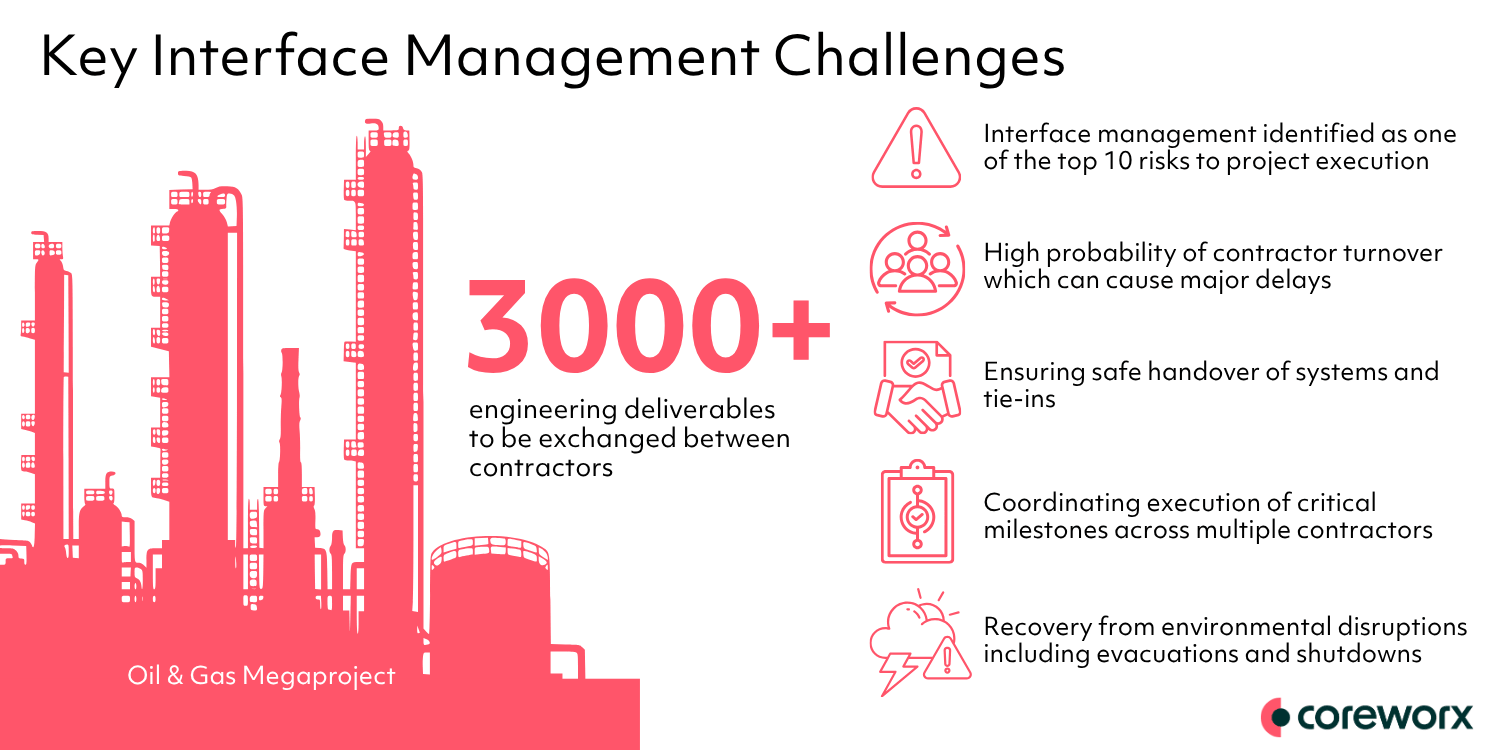
The organization had already identified interface management as one of its top 10 risks to project execution. Given the scale and complexity of this particular project—and the estimated 3,000 engineering deliverables that would need to be exchanged between contractors—it was clear that a different approach was required.
Recognizing that traditional tools such as spreadsheets and email would be insufficient, the project team understood the need for a more structured, transparent, and scalable method to manage interfaces across all phases. To address this challenge, they implemented a formal interface management process anchored in a cultural shift toward a unified “One Team” mindset, supported by the Coreworx platform.
What interface management challenges did the project face?
 From the outset, the project presented significant complexity, defined by its multi‑billion‑dollar estimated cost, international execution strategy, multi‑year timeline, and the logistical challenges of its remote northern location.
This type of complexity is not uncommon with today’s projects. But what sets this project apart are some of the additional challenges that they had to overcome and specifically how Coreworx Interface Management software helped to address those challenges.
Projects manage uncertainty through structured risk planning, financial monitoring, schedule contingencies, and clear governance. Even addressing those external or “Black Swan” risks which can destabilize the project. But while projects can plan for these risks, the real test lies in how they respond when those events actually occur.
The following challenges did arise during the project – some anticipated and others unforeseen; however, each was successfully addressed through effective interface management, the strong performance of the interface manager, and the “One Team” culture they fostered, enabling the project to remain on schedule:
- Multiple contractors with interdependent scopes
- Contractor turnover
- Early greenfield/brownfield operations (a new undertaking that is built completely from scratch/modifying, upgrading, debottlenecking, or expanding an existing, operational facility) and safe handover of tie-ins
- Environmental disruptions, including evacuations & shutdowns
How did Coreworx improve interface management in this oil and gas project?
The executive team received a clear and comprehensive briefing on the project’s key risks. In response, the project implemented a three-pillar approach - People, Process, and Tools - to embed interface management into both its culture and execution framework. Coreworx was selected as the enabling platform, providing the centralized capability needed to support and sustain this strategy.
People: Creating a “One Team” Environment
The project team emphasized collaboration and transparency across all stakeholders, recognizing that success required not only the right tools to support interface management but also a fundamental cultural shift. Silos were actively broken down, aligning all participants around a unified “One Team” mindset—where project priorities consistently took precedence over individual contractor interests, ensuring that decisions were made in the best interest of overall project success.
Key elements included:
- Breaking down communication barriers
- Encouraging contractors to document what they needed from others early
- Driving accountability for commitments
- Providing visibility across all organizations
- Reinforcing that the needs of the project outweigh those of any single contractor when resolving competing priorities
Using Coreworx’s centralized interface register, all participants - owner teams, EPCs, vendors, fabricators, and logistics providers - operated from a single source of truth, reducing ambiguity and strengthening coordination. The register itself supported the project’s “One Team” approach by enabling transparency, shared accountability, and consistent communication across all parties. Executive oversight provided joint venture partners with clear, real-time visibility into interface status across the project.
Process: Standardized, Lifecycle-Wide Interface Management
To support interface management, a standardized Interface Management Plan was developed and consistently applied across all phases of the project. This plan provided a clear, structured process that guided how interfaces were identified, defined, and managed, ensuring alignment across all stakeholders and reinforcing a disciplined, repeatable approach to execution. It established expectations early, embedded interface requirements into project delivery, and enabled proactive coordination throughout the lifecycle.
Key elements of the plan included:
- Early identification of critical interfaces during FEED
- Inclusion of interface requirements in tenders and contracts
- Regular cross-contractor reviews and feedback loops
- Full lifecycle tracking from engineering through construction and handover
By formalizing these practices, the project reduced uncertainty, improved accountability, and ensured that interfaces were actively managed rather than reactively addressed.
To support the project’s Interface Management Plan, the team leveraged Coreworx as its digital backbone, enabling consistent and structured execution across all stakeholders and project phases. The platform reinforced the defined processes, ensuring they were applied uniformly and effectively throughout the lifecycle of the project.
Through its interface register and workflow capabilities, Coreworx facilitated structured collaboration among contractors while ensuring full traceability from engineering through construction and handover. By providing real‑time visibility, clear accountability, and standardized processes, Coreworx operationalized the Interface Management Plan, transforming it from a guiding framework into a practical, enforceable system that enhanced coordination and mitigated interface-related risks.
Tools: Coreworx as the Digital Backbone
Coreworx provided the structure and visibility needed to manage complexity at scale. Coreworx enabled:
- A single source of truth
- Real-time visibility into status, trends, and overdue actions
- Automated notifications and reminders
- Integration with schedule milestones
- Configurable attributes for engineering, construction, and commissioning work packages
- Rapid onboarding for new contractors
This digital foundation ensured consistent reporting, reliable handover documentation, and seamless collaboration across all project phases.
What results did Coreworx interface management deliver?
 The value of the project’s interface management approach became clear when disruption occurred on site. With responsibilities, commitments, and interface status recorded in Coreworx, the team was able to respond quickly to contractor turnover, support safer handovers, coordinate complex tie-ins, and recover from environmental shutdowns while maintaining overall schedule control.
1. Rapid Recovery from Contractor Turnover
Contractor turnover is always a high risk on any project. In this case, it materialized! When a contractor was removed due to safety violations, the project avoided major delays because:
- All outstanding interface agreements were documented in Coreworx
- Who had committed to do what and when, and whether those tasks or activities had been completed
- The discovery team could immediately assess the exact status of work
- Remaining scope was easily packaged for retendering and re-mobilization of the new contractor
- Interface register was used to get the new contractor up to speed quickly
- Complete audit trail, all decisions and communications tracked, all revisions of interface documents accessible
Their structured, tool-enabled approach to interface management—supported by the Coreworx platform—minimized rework and schedule impacts, allowing the project to transition and onboard the new contractor quickly and with minimal disruption. Thanks to this, the project was able to stay on track.
2. Safe Turnover of Systems and Tie-Ins
Early utilities and power systems were activated to support construction. During one handover, Contractor A completed a hydrostatic test and turned the system over to Contractor B for final bolting and tie-in. Unpressurized water from the test remained in the line. This near miss resulted in no lost-time incident and underscored the need for additional checks and greater rigour in handovers.
Establishing ‘soft interface’ agreements (intangible connection points involving data criteria, software boundaries, clearances, or sequential schedules) that confirmed who is going to do what, when they are going to do it, and what they are going to supply, and then including them in handover binders, helped the team achieve a very, very good record of safe turnover of systems and tie-ins into that early operations, early provision to construction phase.
3. Coordinated Execution of Critical Milestones
One major milestone required five contractors to complete tightly sequenced tie-ins in one geographical area within a single week. With limited detailed schedule integration, dependencies were ‘unclear’.
Using the Coreworx interface register, the team:
- Mapped out dependencies and responsibilities
- Established interface agreements, defining priority and collaboration
- Scope and execution timelines were aligned
- Ensured all parties understood timing and constraints
Thanks to this early alignment, collaboration and visibility, the milestone was achieved on schedule.
4. Faster Recovery from Environmental Disruptions
This project, as with all projects, had plans in place to deal with environmental disruptions; they had evacuation plans, shutdown plans, and knew what needed to be done if and when this risk arose.
Environmental events forced multiple site evacuations and weeks of lost time. Because interface agreements were documented in Coreworx up to the moment of shutdown, the team could:
- Immediately identify unfinished work
- Prioritize activities upon remobilization
- Reassign lower priority tasks to later phases
This structured recovery approach helped maintain overall schedule integrity. Another example of where interface management enhanced current business processes, practices, and procedures, and created additional value and benefit for the project team.
What does this interface management case study show?
The organization recognized that effective interface management begins with people, specifically with teams understanding both the value and necessity of managing interfaces well. They identified interfaces as a major source of project risk and responded with a cultural shift that emphasized accountability, collaboration, and disciplined data practices.
By committing to consistently recording and tracking interface data, and building trust in that data, they strengthened coordination, reduced rework, and enabled smoother, more predictable execution across the project.
See how Coreworx can support your next phase by downloading the Coreworx brochure.
Source and Confidentiality Note
This anonymous case study is based on information provided by the project team. At the client’s request, the client and project are not named. Figures and outcomes presented here (including project scale, production potential, engineering deliverable volume, schedule performance, and disruption recovery) are client-reported information and have not been independently audited by Ascertra.