

Project management relies on detailed scheduling at every phase to provide a complete and current overview of the project at all times. Mpower project controls support Primavera P6 users by extending scheduling, estimating, and control capabilities with in-depth, real-time data. From job card creation to detailed day-to-day work schedules, Mpower offers complete end-to-end data for project planners, estimators, and schedulers.
Key takeaways
- Mpower works with Primavera P6 to support project scheduling and planning
- Teams can bring scheduling, estimating and planning activities into a more connected workflow
- More detailed project information helps teams develop and maintain informed plans
- The combined approach gives project teams a clearer basis for estimating and scheduling work
Jump to
- What role does Primavera P6 play in top-down project planning?
- How does Mpower add detailed work steps to Primavera P6 activities?
- How do Mpower and Primavera P6 work together across six levels of scheduling?
- Real-world example: How Woodside used Mpower with Primavera on an LNG hook-up project
- How can you turn a Primavera P6 schedule into a comprehensive project plan?
What role does Primavera P6 play in top-down project planning?
Primavera P6 supports top-down project planning by giving project teams a high-level view of portfolios, schedules, resourcing, risk mitigation, and contract management. This makes it well suited to executive and management summaries, while Mpower can add the detailed scheduling and estimating information needed lower in the work breakdown structure.
Complex projects involve multiple stakeholders, regulatory requirements, and interdependent activities. Different levels of detail are therefore needed for planning, coordination, and execution. Primavera P6 provides the schedule structure; Mpower extends that structure with project controls data for more detailed planning and reporting.
How does Mpower add detailed project data to Primavera P6 activities?
Mpower is Ascertra’s project controls and cost management software. Mpower adds detailed project data to Primavera P6 activities through job cards, work packs (structured packages that group the information needed to plan and execute a defined scope of work), estimating data, time writing, and progress entries. This connects day-to-day execution data with the higher-level schedule, cost, and resource information used for project control.
Job Cards
Job cards define the specific tasks required to complete project activities. In Mpower, teams can create and manage job cards, include them in work packs, and use resource data from estimating norms. The resulting detail can support the development of higher-level activities in the schedule.
Time Writing
Mpower time writing records actual hours and progress against project activities, helping teams compare execution with planned work. It can capture:
-
Labour, equipment, and material timesheets, often referred to collectively as LEMs
-
Productive, non-productive, and overtime hours
-
Entries made by individuals or a central timekeeper
-
Progress linked to time-writing activities
When this information is connected with Primavera P6, project teams have more detailed data for resource allocation, cost control, performance analysis, progress tracking, and schedule accuracy.
Project Procurement
Mpower connects procurement data to project control by tracking supply-chain activity from purchase requisitions through supplier quotes, purchase orders, goods receipts, and purchase invoices. Teams can also view phased cost commitments, back-charge relevant items to clients, and call off stock to work orders, job cards, and CTRs (Cost, Time, Resource) during planning and estimating.
This gives project teams procurement, cost, client-billing, and resource-planning information in the same project-control workflow as the Primavera P6 schedule.
Cost Control
Mpower connects Primavera P6 schedule information with flexible budgets, actuals (recorded project results to date, such as actual hours worked, costs incurred, and progress achieved), variations, change orders, and periodic cost summaries. Primavera P6 provides project-level schedule and reporting structure, while Mpower supports top-down or bottom-up budget definitions and tracks actuals against relevant budgets.
Together, the systems provide a clearer basis for reviewing schedule-linked cost performance and maintaining alignment between planned work, budget, and execution data.
How do Mpower and Primavera P6 work together across six levels of scheduling?
The six-level framework below shows how Primavera P6 can provide schedule structure while Mpower adds detailed job, resource, time-writing, progress, estimating, and cost information:
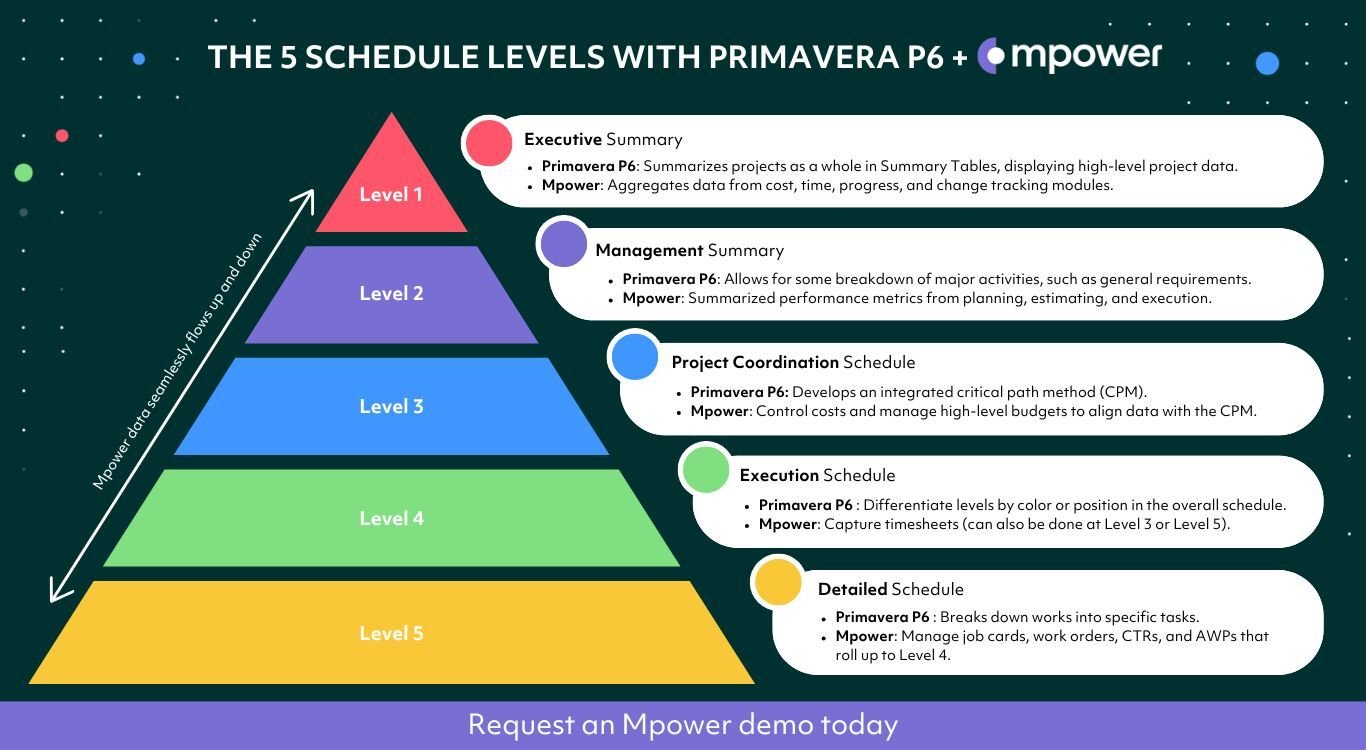
Above: How Primavera P6 and Mpower work together across schedule levels, from high-level project summaries to detailed job cards, linking schedule structure with the cost, resource, progress, and time-writing data needed for project control.
Level 1: Executive Summary
- Primavera P6: Summarizes projects as a whole in Summary Tables, displaying high-level project data in the project view
- Mpower: Aggregates data from cost, time, progress, and change tracking modules to provide key milestones visibility and earned value metrics (performance measures that compare planned work, the value of work completed, and actual cost) at the executive level
Level 2: Management Summary
- Primavera P6: Allows for some breakdown of major activities, including general requirements, preliminaries, and surveys
- Mpower: Summarized performance metrics from planning, estimating, and execution feed into summaries used for client and contractor reporting
Level 3: Project Coordination Schedule
- Primavera P6: Develops an integrated critical path method (CPM), showing dependencies, critical paths, and major milestones across project stages
- Mpower: Supports integration with Primavera, aligning cost and resource data with the critical path. Helps coordinate work by defining scope, estimating resources and durations, and managing job cards
Level 4: Execution Schedule
- Primavera P6: Used for day-to-day scheduling of workforce tasks by level. Users can differentiate levels by its colour or position in the overall schedule
- Mpower: Captures actuals at the task and workforce level, supporting detailed tracking of execution. This data rolls up to enable comparison of actual hours and costs against planned estimates, supporting proactive schedule and budget control
Level 5: Detailed Schedule
- Primavera P6: Breaks down works into specific tasks
- Mpower: Enter or validate daily timesheets, track actuals per work order or job card, and note productivity, enabling granular control over activities. This data can feed into Gantt charts, providing the structure for visual day-to-day tracking
Level 6+: Job Cards
- Primavera P6: Not available
- Mpower: Allows granular estimating of detail work breakdown and summarization of that detail to Level 5 for scheduling
Real-world example: How Woodside used Mpower with Primavera on an LNG hook-up project
This case study describes how Woodside used Oracle Primavera for planning and scheduling during the hook-up stage of its Pluto LNG Project, while Mpower provided the detailed job, resource, time-writing, and progress information needed to control execution. The workflow allowed the team to create and estimate job cards in Mpower, schedule and progress them in Primavera, and pass planned jobs back to Mpower for time writing.
During the project, Mpower recorded nearly 1,000 jobs and more than 30,000 estimated man-hours. The published case study reports that Woodside completed the project on time and on budget.
How can you turn a Primavera P6 schedule into a comprehensive project plan?
You can turn a Primavera P6 schedule into a more comprehensive project plan by adding Mpower’s detailed estimating, job-card, time-writing, procurement, cost, and progress data. This gives project teams a more connected view of planned work, resources, costs, and execution data while retaining Primavera P6 as part of the scheduling workflow.
Book an Mpower demo to explore how this approach fits your project structure, reporting needs, and integration requirements.
Last updated: August 2026